That Oregon Ducks Swag
 For decades, college football uniforms followed an unspoken rulebook: tradition first, experimentation last. Colors stayed fixed, designs evolved slowly, and deviation was often treated as sacrilege. Then the Oregon Ducks changed the conversation entirely. What began as a willingness to question visual norms turned into one of the most influential design movements in modern sports culture.

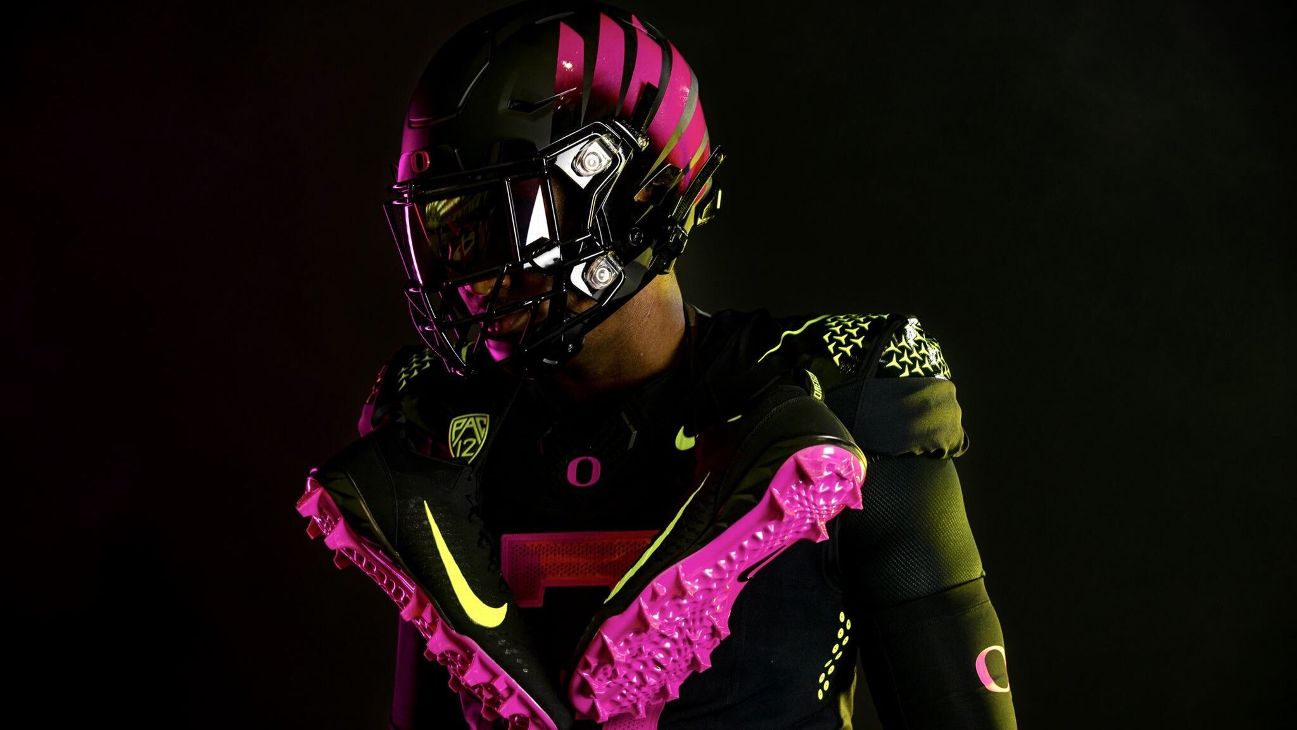
Oregon’s uniforms became a canvas rather than a costume. Pink and white combinations—once considered off-limits in the hyper-masculine world of football—were introduced not as gimmicks, but as statements. They challenged the idea that toughness had a color, and in doing so, reframed how athletes, fans, and designers thought about identity. The result wasn’t controversy for controversy’s sake; it was creative confidence backed by intention.
Design isn’t about breaking rules. It’s about knowing which ones no longer matter.
 The roots of this experimentation trace back to Oregon’s unique position at the intersection of sport and innovation. Proximity to Nike’s design culture created an environment where uniforms were treated as prototypes rather than relics. Each season became an opportunity to test new materials, color stories, and visual language.
Success wasn’t measured solely by wins, but by cultural impact—how a uniform made players feel, how it resonated beyond the field, and how it pushed the aesthetic of the sport forward. By embracing bold palettes and unexpected contrasts, Oregon signaled a larger shift across athletics. Sportswear was no longer just functional; it was expressive.
The roots of this experimentation trace back to Oregon’s unique position at the intersection of sport and innovation. Proximity to Nike’s design culture created an environment where uniforms were treated as prototypes rather than relics. Each season became an opportunity to test new materials, color stories, and visual language.

Success wasn’t measured solely by wins, but by cultural impact—how a uniform made players feel, how it resonated beyond the field, and how it pushed the aesthetic of the sport forward. By embracing bold palettes and unexpected contrasts, Oregon signaled a larger shift across athletics. Sportswear was no longer just functional; it was expressive.
Breaking the Mold
What makes Oregon’s approach enduring isn’t the frequency of change—it’s the clarity behind it. Every iteration feels considered. Pink isn’t used to provoke; it’s used to communicate. White isn’t minimal for simplicity’s sake; it’s intentional restraint. Together, these choices suggest that creativity in sports doesn’t dilute competition—it sharpens it.

In an era where branding, culture, and performance increasingly overlap, the Ducks offer a blueprint. Innovation doesn’t require abandoning history, only reinterpreting it. By trusting designers, empowering athletes, and embracing risk, Oregon turned uniforms into a language of possibility—one that continues to shape how modern sports present themselves to the world.
Today, Oregon’s influence extends far beyond college football. Their design philosophy has become a case study in how creative systems operate at scale—where experimentation, iteration, and cultural awareness coexist with performance demands. The uniforms aren’t remembered simply because they looked different; they’re remembered because they meant something.

In breaking the mold, the Ducks proved a larger truth: creativity thrives where tradition is respected but not protected. And in that space, new standards are born—not quietly, but boldly, in full color.






Nora Becker
September 1, 2015 at 2:13 pmThanks for sharing your ideas in such a straight forward way. Your work is so appreciated worldwide!
Martin Saward
September 1, 2015 at 2:13 pmReally inspirational read, thank you!
Carol Thorn
September 1, 2015 at 2:14 pmAdorably charming! You have an amazing eye for beauty – these photos are so pretty!
admin
September 8, 2015 at 10:12 amThanks on those nice words, we really appreciate it.