



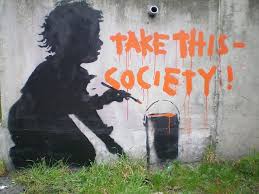
Banksy Didn’t Disappear—He Stepped Aside
Banksy’s work rarely announces itself. It appears overnight, uninvited, on walls that were never meant to host art. By morning, crowds gather. By afternoon, the message has already traveled the world. The artist remains unseen, yet unmistakable.
For decades, Banksy has operated in plain sight while remaining anonymous, building one of the most recognizable bodies of work in contemporary art without ever stepping into the spotlight. His stenciled figures—children, soldiers, rats, policemen—are simple in form and sharp in intent, designed to be understood instantly and debated endlessly.
Banksy’s greatest trick was never hiding his identity. It was making the message louder than the artist.
A public wall becomes a gallery
What makes Banksy’s work endure is not just the imagery, but the placement. His art lives where people already are—on city streets, border walls, abandoned buildings. There is no ticket booth, no opening night, no permission granted. The work belongs to the public the moment it appears, even as authorities rush to remove it.
That tension—between preservation and erasure—is part of the art itself.Banksy’s visual language is intentionally accessible. Bold silhouettes, limited color palettes, and instantly readable scenes allow the message to land before the viewer even realizes they are engaging with art. The simplicity is deceptive—each piece is layered with political critique, social commentary, and dark humor.
Recurring figures populate Banksy’s world: children reaching for hope, authority figures rendered absurd, animals standing in for human instincts. These characters return across cities and years, creating a loose narrative that feels both global and deeply personal.
Critics remain divided. Some argue Banksy has become too mainstream to be subversive. Others see his continued relevance as proof that the issues he highlights—power, inequality, surveillance—remain unresolved. Whether celebrated or dismissed, the work is rarely ignored.
Ironically, the same institutions Banksy critiques often race to claim his work once it gains value. Walls are removed, auction prices soar, and street art becomes collectible—raising uncomfortable questions about ownership, intention, and authenticity.
The power of staying unknown
Banksy’s anonymity is not a gimmick—it’s a strategy. By removing the artist from the conversation, the work stands on its own. There is no face to celebrate, no personality to defend, no biography to distract from the message. The art speaks first, last, and loudest.
``Banksy didn’t disappear so the work could be mysterious. He disappeared so it could be honest.``
In a world obsessed with visibility, Banksy remains a reminder that impact doesn’t require presence. The mystery endures not because we don’t know who he is—but because the questions he raises are still unanswered.




Nora Becker
September 8, 2015 at 9:21 amThanks for sharing your ideas in such a straight forward way. Your work is so appreciated worldwide!
Martin Saward
September 8, 2015 at 9:27 amReally inspirational read, thank you!
Carol Thorn
September 8, 2015 at 9:38 amAdorably charming! You have an amazing eye for beauty – these photos are so pretty!
admin
September 8, 2015 at 9:56 amThanks on those nice words, we really appreciate it.